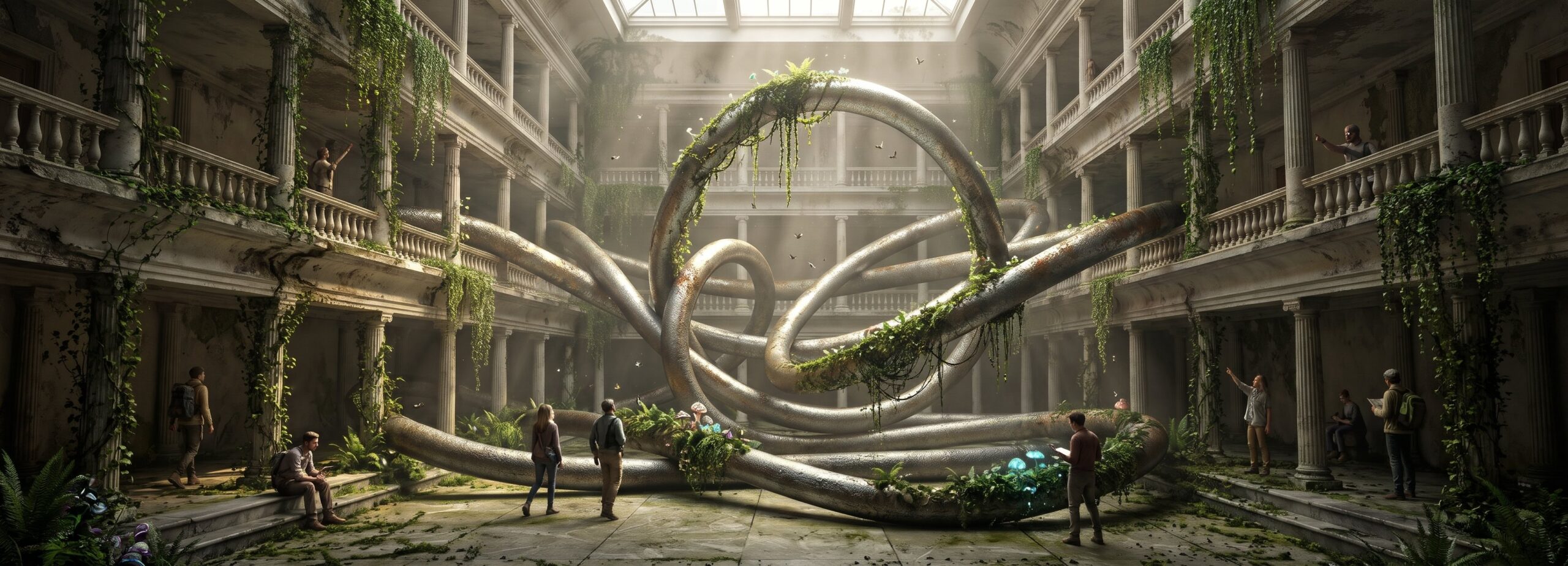
From Aristotle’s final causes to Kant, quantum mechanics, and the modern understanding of causation
Causality has fascinated me for a long time. Perhaps because it concerns something so familiar that we rarely stop to examine it. We live in a world in which things happen, actions have consequences, and events seem to follow one another according to intelligible patterns. We assume that there are reasons why things turn out as they do. But what exactly do we mean when we say that one thing causes another? And where, precisely, is the cause?
The question has accompanied me through much of my philosophical reading, beginning with Aristotle and Thomas Aquinas, continuing through Hume and Kant, and eventually leading to the rather strange world of contemporary physics. Along the way, I have become less convinced that causality is something we simply discover in nature. Yet I find it equally difficult to accept that it is merely something we impose upon an otherwise indifferent universe. When somebody asks: Why? – We try to give a causal explanation, but this can be done in different ways.
1. Aristotle and the attraction of final causes
My early interest in causality was shaped by Aristotle (384–322 BCE) and Thomas Aquinas (1225–1274). What appealed to me particularly was Aristotle’s concept of the final cause, the idea that something can be explained not only by what brought it about, but also by what it is directed toward. A simple example from Aristotle (Physics II.3): Why is she walking after dinner? For the sake of her health.
Aristotle famously distinguished four causes: material, formal, efficient, and final. Consider a tree. We can explain it through the material from which it is constituted, the form that makes it a particular kind of organism, and the processes that bring about its growth. But Aristotle adds another dimension: the tree develops toward maturity, producing leaves, roots, and eventually seeds. Its development is intelligible in relation to what it becomes.
I have always found this conception attractive because it gives nature something resembling agency, although not necessarily consciousness or intention. A plant grows toward light, an animal searches for food, and a human being pursues a goal. Each behaves in ways that are intelligible through its orientation toward certain outcomes.
In Aquinas, this conception becomes part of a larger metaphysical order, in which natural things possess their characteristic inclinations and act toward ends. There is something reassuring about this picture. The world is not merely a collection of particles being pushed around. Things have their own tendencies, capacities, and directions of development, and ultimately they arrange themselves into a natural whole, the cosmic order of nature, “ordo naturalis,” that has illuminated the Christian faith for centuries.
Of course, the difficulty is obvious. Are these purposes really present in nature, or are we projecting human intentions onto natural processes? A plant does not want sunlight as I might want a glass of wine. Yet describing its behavior without any reference to its biological functions seems equally unsatisfactory.
The scientific revolution largely resolved this problem by abandoning final causes as explanations of fundamental physical processes. Galileo (1564–1642), Descartes (1596–1650), and Newton (1642–1727) developed a conception of nature governed by mathematical laws and mechanical interactions. Instead of asking what something exists for, science increasingly asked what conditions produced it.
This shift made modern science extraordinarily successful. But I wonder whether something was also lost: the idea that nature might contain intrinsic forms of directedness rather than merely externally describable movements.
2. Hume and the invisible connection
David Hume (1711–1776) introduced what remains, for me, the deepest difficulty in the concept of causality.
When I watch one billiard ball strike another, I see the first ball move, make contact, and the second ball begin to move. But what exactly have I observed? Motion, contact, succession. I have not observed some additional entity called causation connecting the two events.
This is Hume’s unsettling insight: we never perceive the necessary connection between cause and effect. We observe events and their regular conjunctions, but not the necessity that supposedly binds them together.
We become accustomed to certain patterns and expect them to continue. Fire burns, stones fall, the sun rises. But no amount of repeated observation establishes, by itself, that the future must resemble the past.
The problem is more radical than ordinary scientific uncertainty. It concerns the logical foundation of our expectations about the world.
I find Hume difficult to refute. Even in contemporary science, what we actually observe are measurements, changes, and statistical relationships. We infer causal connections from them, often with extraordinary reliability. But the inference remains different from observing necessity itself.
And yet reducing causality to regular succession still strikes me as inadequate. When I turn on a light, I do not merely expect illumination because similar events have occurred before. I understand myself as doing something that makes a difference in reality. Causality seems inseparable from our experience of acting in the world.
3. Kant: Is causality a property of the mind?
Immanuel Kant (1724–1804) accepted Hume’s central problem but proposed a remarkable reversal: Perhaps causality cannot be derived from experience because it is one of the conditions that make experience possible.
In the Critique of Pure Reason (1781), Kant describes causality as a category of the understanding. But what does that actually mean?
Consider a simple example from Kant’s Second Analogy of Experience. I look at a house, first noticing its roof and then its windows. My perceptions occur in succession, but this does not mean that the roof existed before the windows. Their order is determined by how I look.
Now imagine watching a boat move downstream. Here, the order is different. The boat occupies one position and then another. I understand this as an objective event, not merely a sequence of perceptions, because I assume that the succession follows a rule governing the boat’s movement.
For Kant, causality is precisely what allows us to distinguish an objective event from a merely subjective succession of impressions.
This is an astonishing argument. Causality is not something added to experience after we observe enough repetitions. It is part of the conceptual structure through which we experience events as belonging to an objective world.
But does this mean that causality exists only in our minds? Not quite. Kant is not suggesting that we invent the natural world according to our preferences. Rather, the world as we experience and scientifically investigate it is necessarily organized through certain fundamental concepts. Causality has objective validity for appearances, although we cannot simply extend it to things as they might exist independently of all possible experience.
What interests me is the implication: perhaps causality tells us as much about the conditions of human understanding as it does about the ultimate nature of reality.
Kant’s argument nevertheless leaves me with a question. If causality is a necessary condition of experience, what happens when modern physics describes a reality that does not seem to conform to our ordinary causal expectations?
4. Quantum mechanics and the limits of causality
The development of quantum mechanics in the 1920s profoundly complicated the classical picture.
At the microscopic level, certain events, such as radioactive decay, are described probabilistically. We can calculate the probability that an atom will decay within a given period, but standard quantum theory does not assign a definite moment of decay in advance.
Furthermore, quantum entanglement reveals correlations between spatially separated systems that cannot be explained through familiar classical models of independent objects carrying predetermined local properties.
None of this proves that causality disappears at the quantum level. Quantum states evolve according to precise mathematical rules, and different interpretations of quantum mechanics offer different accounts of determinism and causal structure.
Nevertheless, it raises a possibility I find increasingly interesting: perhaps causality, at least in its familiar form, is not a fundamental property of the universe but an emergent feature of the macroscopic world?
At the level of everyday experience, objects possess relatively stable identities, events unfold in recognizable sequences, and interventions have predictable consequences. At the quantum level, these assumptions become more difficult to sustain.
The emergence of classical behavior through interactions between quantum systems and their environments, often discussed in terms of decoherence, helps explain why the macroscopic world appears more definite and stable. The thermodynamic direction of time also contributes to the asymmetry between causes and effects.
This does not establish that causality exists only at the macroscopic level. It does suggest that our ordinary concept of causation may depend upon physical conditions that are not themselves fundamental.
I find this possibility fascinating because it changes the philosophical question. Instead of asking whether every event must have a cause, we might ask under what conditions it becomes meaningful to describe events in causal terms.
5. How should we understand causality today?
Contemporary philosophy has developed several approaches that, in my view, help us reconsider the problem.
David Lewis (1941–2001) proposed a counterfactual account: roughly, an event is causally dependent on another when, had the first not occurred, the second would not have occurred. This captures something essential about causal reasoning. We understand causes by imagining how things might have turned out differently.
Probabilistic theories recognize that causes need not guarantee their effects. Smoking causes cancer not because every smoker develops cancer, but because smoking changes the probability of developing it.
More recently, Judea Pearl and James Woodward have developed sophisticated interventionist approaches. The relevant question becomes: what would happen to one variable if we changed another under appropriately controlled conditions?
I find interventionism compelling because it reconnects causality with action. We understand causal relationships by discovering what makes a difference and what we can change. Yet interventionism is not a complete metaphysics. It tells us how to identify and investigate causal relationships without necessarily explaining what makes those relationships real.
This brings me back, somewhat unexpectedly, to Aristotle.
Modern biology continues to use notions of function, organization, and goal-directedness. The heart pumps blood; organisms regulate their internal environments; animals behave in ways directed toward survival and reproduction. Evolutionary theory can explain how many such functions originated without appealing to conscious design or predetermined cosmic purposes.
Perhaps there is room here for a modest rehabilitation of Aristotle’s final causes—not as mysterious forces pulling events toward future outcomes, but as descriptions of the organized capacities through which living systems maintain themselves and pursue characteristic possibilities.
6. Causality as an emergent form of intelligibility
Where does this leave us?
I am inclined to think that causality is neither simply an objective necessity hidden behind events nor merely a habit of the human mind. It may be a form of intelligibility that becomes especially powerful at certain levels of reality.
This is not to say that causes are imaginary. Causal relationships are constrained by the world. A medication either changes the course of a disease or it does not; a bridge either withstands a particular load or it collapses. Our causal explanations can be mistaken, and reality corrects them.
But causality may not exist in precisely the same way at every level of nature. The causal language appropriate to human intentions differs from that of molecular biology, and both differ from the mathematical descriptions of quantum mechanics.
I would therefore resist the temptation to reduce all forms of causation to a single underlying mechanism. Different levels of organization may support different, equally legitimate forms of causal explanation.
In a certain way, this conclusion returns us to the beginning. Aristotle understood causality broadly as an answer to the question why? Hume showed that the necessary connection we seek is never simply given in observation. Kant argued that causal order is indispensable to our experience of an objective world. Contemporary physics suggests that the very applicability of familiar causal concepts may depend upon the scale and organization of the systems we investigate. Perhaps the ultimate question is not whether causality exists, but why a universe described at its most fundamental level through mathematical relations should give rise to a world in which causes, purposes, and actions are so indispensable. And perhaps Aristotle’s original insight was not entirely mistaken: to understand something is not merely to reconstruct the sequence of events that preceded it, but to understand how it belongs to an organized world in which some possibilities are realized and others are not.
I began with the attraction of final causes because they seemed to restore agency and purpose to nature. I am no longer convinced that nature possesses purposes in Aristotle’s original metaphysical sense. But neither am I satisfied with the idea of a world consisting merely of events following one another.
Between these two conceptions lies, I suspect, the most interesting philosophical territory: a world without predetermined purposes, but one in which organized forms of life, action, and understanding can nevertheless give rise to genuine causal powers.
Further reading:
- Aristotle on Causality — Stanford Encyclopedia of Philosophy.
- Medieval Theories of Causation — Aristotle’s legacy and medieval accounts of final causation.
- Kant and Hume on Causality — Kant’s transcendental response to Hume.
- Teleological Notions in Biology — Modern approaches to biological functions and purposes.
- Causation in Physics — The role of causal concepts in contemporary physics.
- Causal Models — Counterfactual and interventionist theories of causation.