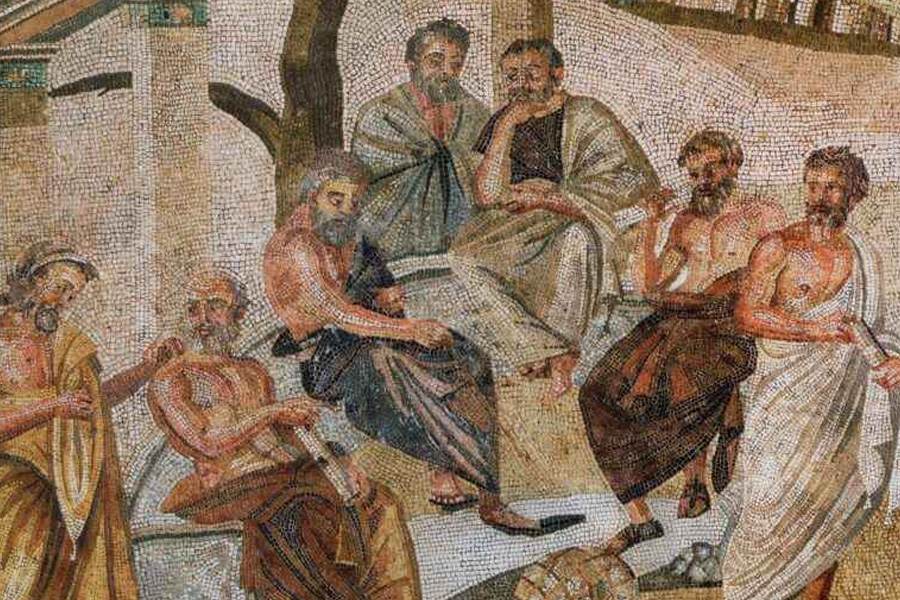
Imagine two people arguing, with nothing above them. No judge, no evidence that could embarrass either side, no standard except the outcome itself. Whoever prevails is right, because prevailing is all that “right” can mean here. Now imagine the same two people arguing under something neither of them controls—a truth that could convict them both, the way two litigants stand before a judge who belongs to neither party. The first picture is sophistry. The second is philosophy. Plato’s Gorgias (387BC) is the story of the difference, and the difference comes down to a third term: the presence or absence, in any conversation, of something that exceeds both speakers.
This is why the Gorgias remains one of Plato’s most unsettling dialogues, and why it reads today like a diagnosis. Our own technologies of persuasion—political, commercial, algorithmic—have perfected the first picture. They measure speech by its effect and by nothing else. What Plato criticized in the rhetoric schools of Athens, we have automated.
“Who Is He?”
The dialogue opens with a question that seems merely social. Socrates arrives late and has his friend Chaerephon ask the famous visitor: “Who is he?” Gorgias could answer with a name, a city, a lineage. Instead he answers with a capacity. He is a teacher of rhetoric, a master of persuasion, and he offers to prove it by taking any question from the audience. His identity is his power over others: he is who he is in the eyes of whoever he can convince.
Plato puts this exchange first because the whole dialogue is folded into it. To ask “who is he?” is to assume that a person is constituted in speech—that identity is not a possession one displays but a claim one makes before others. The question is how the claim gets settled. For Gorgias, I am what my speech does to you. For Socrates, I am what my speech commits me to. And this is why Socratic refutation cuts so deep. When cross-examination exposes a contradiction, it does not merely defeat a proposition. It reveals that the speaker does not hang together—that he is, for the moment, no one in particular, only a bundle of claims that cannot live in the same soul. Socrates says as much to Callicles, in one of the most personal sentences he ever utters: better that the whole world disagree with me than that I be out of tune with myself. Who am I? and What is true? turn out to be the same question, asked in two directions. One becomes someone by being answerable.
Three Versions of the Same Position
The dialogue descends through three interlocutors, and each strips a layer of politeness from the same underlying view of speech.
Gorgias gives it its respectable form. Rhetoric, he boasts, produces conviction without knowledge: the orator persuades the assembly more effectively than the doctor persuades his patient, on any subject, understanding none of them. Pressed on the morality of such power, he claims he also teaches justice—then adds that he cannot be blamed if his students misuse the art. Socrates draws the inference that undoes him. If Gorgias really imparted knowledge of justice, his students could not use it unjustly, for no one who genuinely knows the good chooses the worse. Gorgias can keep the fee or the alibi, not both. What survives the collapse is an honest description of his art: speech answerable to nothing but its own success.
Polus, his young admirer, drops the politeness. The point of such power, he says openly, is pleonexia—the desire always to have more, more wealth, more standing, more power over others—and its perfection is the tyrant, who does whatever he pleases to whomever he pleases. Isn’t such a man enviable? Socrates answers with the most scandalous claims in the dialogue: it is worse to do injustice than to suffer it, and the wrongdoer who escapes punishment is more wretched than the one who is caught, because injustice is a sickness of the soul and punishment its cure. Polus laughs, appeals to what everyone believes, and finds that Socrates simply declines to be an audience.
Callicles, an ambitious politician, gives the position its philosophy. Morality, he argues, is convention—a treaty of the weak against the strong. Nature knows only the stronger and the weaker, and the truly superior man enlarges his appetites and serves them without limit. Socrates’ reply has lost none of its force: such a man is not free but enslaved. His soul is a leaky jar, poured into endlessly, holding nothing. Where nothing stands above desire, desire has no shape, and a desire without shape is not sovereignty. It is bottomless need.
What Socrates Does Differently
The heart of the Socratic alternative appears early, in a sentence that sounds like courtesy and is in fact the whole method. I am the kind of man, Socrates tells Gorgias, who is glad to refute a falsehood and glad to be refuted—and more glad to be refuted, since it is a greater good to be freed from error oneself than to free another.
Sit with that sentence for a moment. No sophist could say it, because in a contest of two, refutation is simply loss. It makes sense only if something is present in the conversation that benefits both speakers no matter who wins: the truth of the matter, from which each stands at some distance, and toward which being refuted is movement. Here is the third term, and here is the real difference between the two kinds of speech. Sophistic speech is validated by the audience—applause, votes, the verdict of the many. Socratic speech is validated by one thing only: the considered agreement of the single person one is talking to, won step by step under the pressure of his own consistency. Socrates repeatedly waves away the crowd and demands the witness of the one man before him—and behind that witness, the impersonal force of the argument itself. Two speakers, bound by a third that neither owns. That is dialectic in the Socratic sense. And that is why it wounds: it closes every exit that charm, intimidation, or majority opinion might offer, and leaves a person alone with the question of whether his life holds together.
Hence the medical metaphor that organizes the dialogue’s second half. Rhetoric stands to the soul as pastry-making stands to the body: a flattery that consults only the patient’s pleasure. Medicine consults something the patient may not feel and often resists—the good condition of the whole. Flattery answers to the audience; therapy answers to health. When Callicles falls into sullen silence, it is Gorgias, changed by his own defeat, who urges him on: take the medicine. The dialogue’s first patient prescribes for its last.
The Good as the Third
What, then, is this third? In the Gorgias it goes by several names—the argument, justice, order, the health of the soul—and Plato has not yet gathered them into his doctrine of the Forms. But the essential features of what the Republic will call the Idea of the Good are already at work, and they are precisely the features of a genuine third term. It cannot be reduced to the two parties: the Good is not Socrates’ preference prevailing over Callicles’, and Socrates insists he argues under the same constraint as everyone else, owning no doctrine, only questions. It is not a compromise: the Good does not split the difference between justice and greed. And it exceeds every formulation: definition after definition fails in the dialogue, yet the failures never feel nihilistic, because each collapse makes the orientation more binding. The Good is that toward which the soul must turn to be healthy, and it withdraws from every attempt to possess it. Transcendence is first experienced as resistance—as the discovery that speech will not say whatever we want it to say—long before it is named as a metaphysical principle.
Plato marks this with his closing gesture. Where argument ends, he places a myth: souls after death, stripped of bodies, rank, and eloquence, examined naked by a naked judge for the scars their injustice has left. Callicles hears an old wives’ tale. But notice who stands at the center of the image. A judge is the very figure of the third—not a party to the conflict, not a compromise between the parties, but the one before whom both must appear. The myth says what the whole dialogue has said, now in a form no clever answer can reach: the last word about a life does not belong to that life’s own rhetoric. The Good judges; it is not judged.
Readers of this blog will recognize the pattern. This is what I have elsewhere called trialectics: the claim that every meaningful relation between two terms depends on a third that is not their sum, not their midpoint, not their settlement, but an other that transforms the relation itself. The judge between litigants; the hidden common ground that lets a metaphor connect two unlike things; in Lacan’s language, the symbolic order that breaks open every imaginary pair and makes both selfhood and speech possible. Two features of the third matter most here. It cannot be derived from the two—which is why the Good can judge the speakers rather than merely express them. And it is never finished—which is why the Gorgias ends in a myth and an exhortation rather than a doctrine, and why the examination must be repeated in every generation and every conversation. Unlike Hegel’s synthesis, the Platonic third is never absorbed into a result. It remains other. That permanent otherness is what the tradition calls transcendence.
The Perfected Dyad
The contemporary force of the dialogue is usually put too weakly, as if it merely reminded us that politicians spin stories. The application of the dialog to contemporary culture leads to a devastating diagnosis: Our dominant technologies of speech are built on the sophistic model and measure success as Gorgias did: conviction produced, nothing else. Today, companies, states, and all kinds of social institutions are perfecting the skills of producing ideologies. People find pleasure in producing images of themselves that are shaped by approval ratings: The recommendation algorithm optimizes the loop between speaker and audience against a single criterion, engagement—which is to say, pleasure and its profitable cousins, outrage and craving. Nothing in the objective function plays the role of the judge. Political speech is composed backward from polling: the applause of the assembly, made continuous and quantitative. And the newest speech technology of all, the AI system tuned to user satisfaction, repeats Gorgias’s boast almost word for word—fluent on every subject, rewarded for telling each listener what he is disposed to accept. However vast its knowledge, a system optimized this way drifts toward flattery as surely as pastry-making. Even the leaky jar has found its interface: the infinite scroll is Callicles’ soul rendered as product design, an appetite enlarged precisely so that it can never be filled.
The point is not nostalgia for an agora, a market place for healthy political, social, and religious activities that never existed. It is diagnostic. What we call the crisis of truth is not, at bottom, a problem of content—misinformation to be corrected with more information. It is a problem of structure: the quiet removal of the third from the places where we speak. Where every utterance is scored by its effect on an audience, the question “but is it true?” has nowhere to stand. The Socratic response is not a technique but a practice: to restore, wherever we speak seriously, some instance that neither party controls—evidence that can convict us, consistency that can shame us, a good that we serve rather than deploy. Philosophy, the Gorgias teaches, is exactly this discipline. It is the refusal to let conversation close into a contest of two, and the patient, sometimes painful openness to the third that judges us all. That openness has an old name: transcendence.